


Loading...


In the digital age, the concept of the smart city is evolving beyond mere technological connectivity towards an ecosystem of meaningful conversations — where technology serves to enrich human interactions. Semantic CityBrain embodies this transformation, moving beyond the traditional Internet of Things (IoT) to usher in the Internet of People (IoP): a smart city management paradigm that genuinely understands and accounts for human context. This new approach conceives cities as warm-blooded organisms, where the urban fabric is not simply a network of sensors but a living space of continuous dialogue between citizens, services and spaces.
Smart cities and tourist destinations face the need to evolve beyond the basic technological connectivity of the Internet of Things, where devices exchange data without truly understanding human context. City managers struggle with data lakes that become swamps of unstructured information, whilst citizens and visitors encounter fragmented services that fail to respond to their real needs or engage them in meaningful conversation.
The revolution lies in a unified knowledge graph that acts as the city's "artificial mind", interpreting complex urban relationships through a Composite AI that fuses the precision of Symbolic AI with the adaptability of Generative AI.
In this technological environment, where Semantic CityBrain operates, knowledge graphs function as the symbolic brain of a trustworthy and auditable AI. They not only guarantee safe, predictable and consistent outcomes, but also ensure ethical, traceable and third-party reproducible operation — making it possible to demonstrate compliance with regulations and standards.
The goal goes beyond data management to achieve a genuine interpretation of how people experience and construct meaning in their surroundings. A smart city — or, in a tourism context, a smart destination — no longer simply knows its resources; it understands how those resources resonate with the unique aspirations of each individual, enabling personalised conversations that evolve with every interaction.

In the tourism sector, recognising that reality matters means moving towards the construction of a large, universal, global and unified knowledge graph — hybridised with statistical technologies and operated with LLMs for specific services. The goal is twofold: to accurately represent the full set of relevant facts that define a destination, and to generate conversational systems capable of holding meaningful dialogues with people, always grounded in truth.
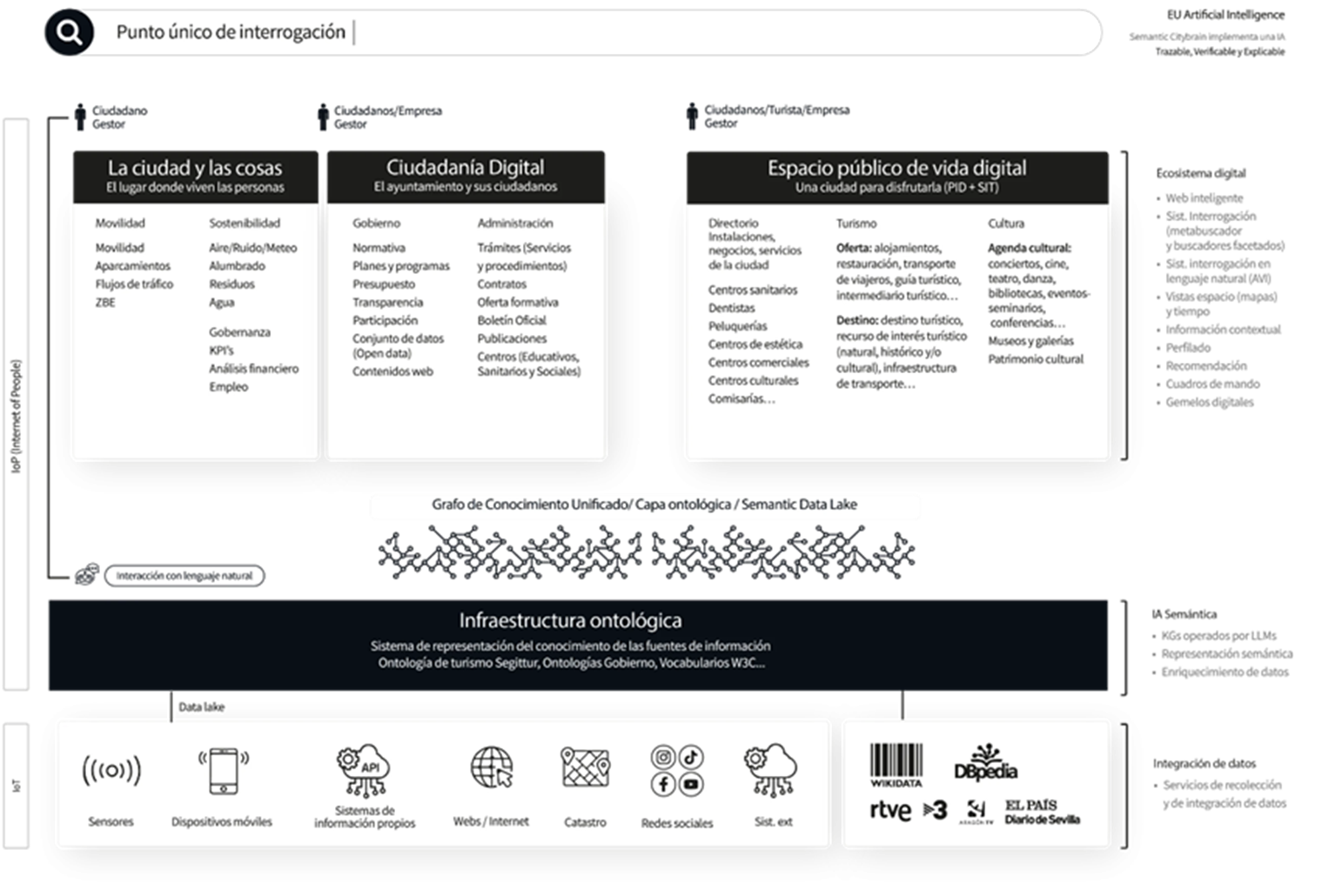
Semantic CityBrain goes beyond the simple technological integration of systems and objects; it creates an intelligent digital ecosystem where mobility, sustainability, governance and culture interact through an ontological layer — the cognitive substrate that gives shape to cities and destinations: their artificial mind.
Semantic CityBrain builds and manages this set of experiences through a cognitive architecture organised across three levels:
The implementation of the Tourism-Spain Ontological Model positions the country at the forefront of global tourism innovation, fundamentally transforming the way tourism information is managed, shared and consumed. The model not only enhances the tourist experience — it revolutionises industry processes, opening up new business opportunities in the digital economy.
Within this technological horizon, tourism is redefined as a continuous dialogue between people and places — a dialogue mediated by intelligent systems that act as invisible facilitators of meaningful encounters. The future of smart tourism, driven by technologies such as those hybridised and interconnected in Semantic CityBrain, with knowledge graphs as the cognitive foundation of our artificial systems, promises a reconciliation between technological efficiency and the authenticity of human experience.
This transformation redefines our understanding of what it means to travel, democratises access to enriching cultural experiences, and promotes a more sustainable, inclusive and humanised form of tourism.
